

News
Are you interested in the latest GWS news? Follow us on LinkedIn!
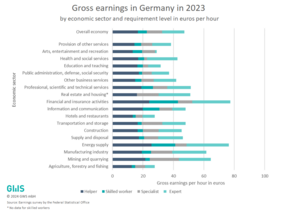
An vocational training promises 35% higher earnings
In August, many people in Germany will start their vocational training. The Federal Statistical Office's earnings survey shows that vocational qualifications pay off in the long term. According to this survey, a completed vocational…
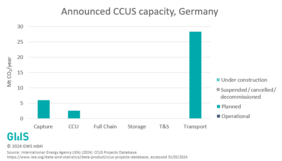
Carbon Capture, Utilization and Storage (CCUS) – status quo?
In February of this year, the German government adopted a carbon management strategy that regulates the storage (CCS) and use (CCU) of CO2 for the first time. The background to this is the realization that in certain sectors, CO2…
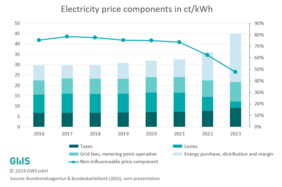
Energy costs for households are still high – the savings potential is not being fully utilized
Private households consume energy primarily in the form of natural gas for space heating and electricity for process heating and cooling (washing and cooking as well as cooling and freezing), lighting and information and communication…
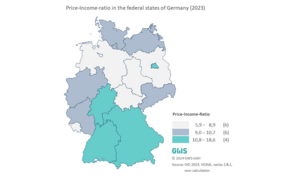
Are single-family homes more affordable due to the price decline?
After property prices for a decade only knew one direction, they experienced a turnaround from the late summer of 2022 on. This was primarily due to the end of the ECB's zero interest rate policy and the subsequent continuous sharp rise…
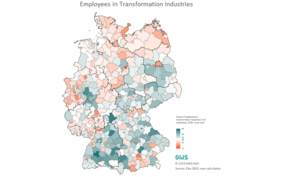
Transformation industries in the region
Germany is facing the challenge of a profound socio-ecological transformation. Climate change, the scarcity of resources and the loss of biodiversity require a fundamental change in our society and economy in order to shape a sustainable…

MEFMI-GIZ Webinar: Using Macroeconomic Models for Assessing Climate Change Adaptation Measures on National Economies
Anett Großmann and Frank Hohmann are delighted to accept MEFMI's (Macroeconomic and Financial Management Institute of Eastern and Southern Africa) invitation to present the use of macroeconomic models to analyze the economic impacts posed…
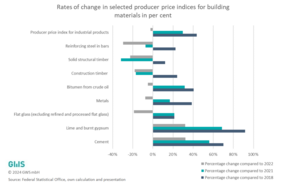
Prices for building materials remain at a high level
The construction industry, one of the most important sectors of the domestic economy, is currently in crisis. According to the Ifo Institute's business climate indicator, sentiment in the construction industry continued to deteriorate in…
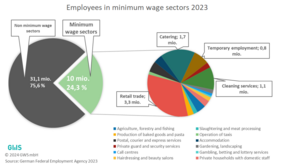
Ten million employees could benefit from the minimum wage increase on 1 January 2024
A general statutory minimum wage has been in force in Germany since 1 January 2015, which sets the minimum wage for employees in all sectors and occupations. On 1 January 2024, it will increase to €12.40 gross per hour, having last been…
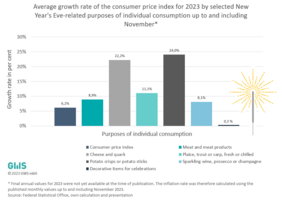
Expensive New Year's Eve – above-average price increases for ingredients for a good New Year's Eve party
The year 2023 is drawing to a close and the New Year's Eve party is just around the corner. Traditionally, champagne, New Year's Eve carp, ingredients for a fondue or raclette meal and party snacks are on the shopping list for this…
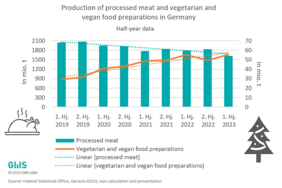
Veggie or meat for Christmas?
Less and less meat is being eaten in Germany. While meat was considered an indicator of prosperity in this country many years ago, as is currently the case in China, for example, its reputation and consumption have been falling noticeably…