

News
Are you interested in the latest GWS news? Follow us on LinkedIn!

Update and extension of the Algerian model e3.dz completed
Work carried out as part of the GIZ project "Policy dialogue and knowledge management on low emission development strategies in the MENA region" (DIAPOL-CE) on the model already developed by GWS for the Gesellschaft für Internationale…
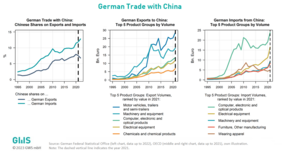
Import dependency on China continues to grow
For some years now, a debate has been sparked in Germany about the resilience of supply chains and dependencies on individual states. In 2022, this debate was largely driven by the Russian war of aggression on Ukraine, which unsparingly…
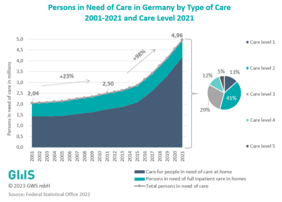
Number of people in need of care in Germany doubles to 5 million within ten years
The latest care statistics show that there will be around 4.96 million people in need of care in Germany in 2021, a huge increase on previous years. All persons who receive benefits from social long-term care insurance are counted as…
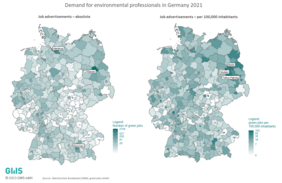
Demand for environmental professionals in Germany 2021
The consequences of climate change are increasingly being felt in Germany. It is estimated that since 2000, damage caused by climate change impacts in Germany has averaged 6.6 billion euros per year. The floods in the Ahr valley and the…
New videos on the CRED project: How can climate risks and climate adaptation be integrated into macroeconomic modelling?
The Deutsche Gesellschaft für Internationale Zusammenarbeit (GIZ) GmbH has published two informative videos about the CRED project. In addition to insights into the management of climate risks and climate adaptation with macroeconomic…
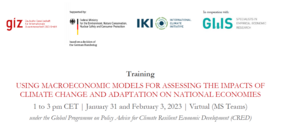
Virtual training: Using macroeconomic models to assess the impacts of climate change and adaptation on national economies.
This training is offered to share experience from the CRED programme in piloting the development and application of such models in Georgia, Kazakhstan and Vietnam. The CRED programme developed together with experts from the Institute of…
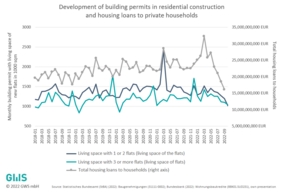
Our figure of the month for New Year's Eve 2022: Who is still building – in 2023?
The recent development of building permits has both caused excitement in the construction industry and dampened the anticipation of Christmas and the turn of the year. Increasingly, the question arises whether households can afford to…
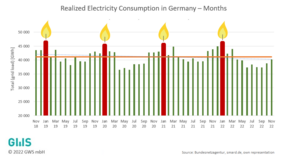
Our figure of the month for Christmas 2022: Advent, Advent, no lights are on
Data from the German Federal Network Agency on realized electricity consumption by month shows that in previous years, however, peak values were not reached in December but in January. This is apparently due to the higher number of public…
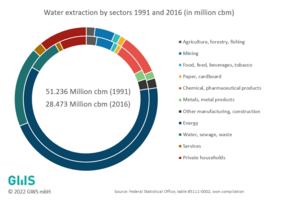
Our figure of the month 12/2022: Water extraction almost halved since 1991
Since 1991, water extraction has been almost halved through the use of water-saving technologies and processes and amounts to approximately 28 billion cubic meters per year. The energy sector, the manufacturing industry and private…
Our figure of the month 11/2022: Nine times higher transport performance of passengers in coach transport
Long-distance bus transport experiences the greatest ups and downs in passenger transport
The boom in long-distance coach transport, triggered by the liberalisation of the market in 2013, came to an end even before the Corona crisis and…